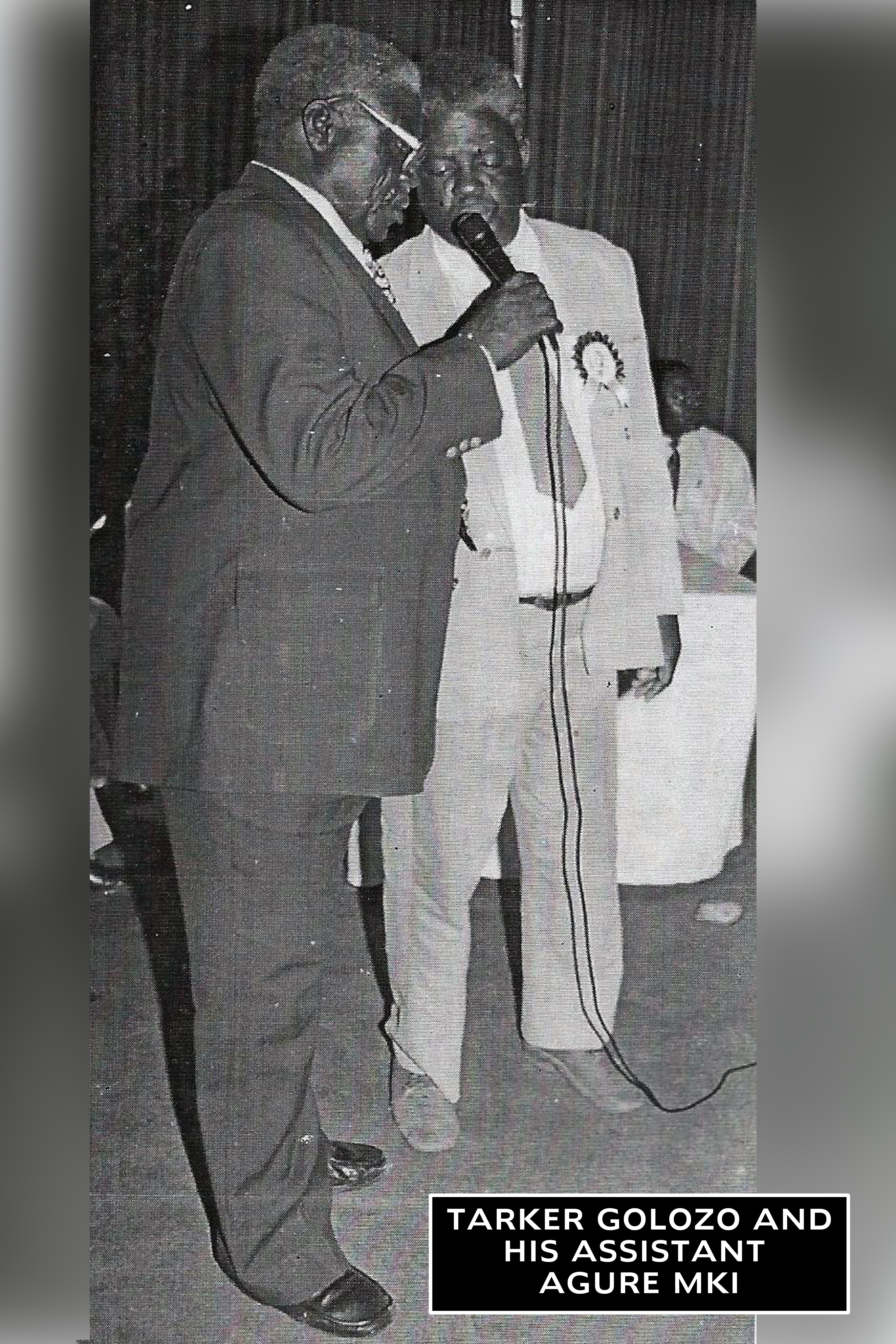
Tarker Golozo (1932–2000) was a celebrated Tiv oral poet, singer, and educator from Ikumbur, Mbatiav District, Gboko Local Government Area, Benue State, Nigeria. He was known for his powerful performances, lyrical composition, and contribution to Tiv oral tradition, often using music and poetry to educate, mobilize, and critique social and political life.
Golozo was born in 1932 to Mr. and Mrs. Golozo in Ikumbur. He was one of five surviving children of his father, alongside Zwabo, Saave, Tyozenda, and Demvihin. His father had multiple wives, some of whom divorced, died, or left the family. Golozo’s extended family also included three brothers—Akumun, Kwashinkyer, and Ikocer—who all lived in the same compound.
By 1998, Golozo had ten wives living with him and over forty-five children, most of whom were attending school. To provide for his large family, he supplemented his income from singing with farming, reflecting this dual occupation in songs such as Fetalaiza Hemba Imborivungu ("Fertilizer is greater than Imborivungu").
Physically, Golozo was described as a well-built man of imposing stature, standing approximately six feet tall, with prominent tribal marks of the kusa (nail scarification) type. His physique, energy, and presence were often remarked upon by contemporaries and researchers.
Golozo attended Roman Catholic Mission (RCM) Primary School, Lough, from 1944 to 1950, completing up to Standard Four. He acquired basic proficiency in English, which later influenced his song lyrics.
He was later invited by Rev. Fr. Turner to teach at RCM Lough, and subsequently transferred to RCM Azomon in Mbatiav. Golozo taught for seven years before resigning to focus on music. His exposure to Western education helped him integrate English terms into his Tiv compositions.
Golozo did not inherit his musical skills from his family; instead, his art developed through experience and circumstance. As a child, he composed songs to ridicule peers who misbehaved or stole, and later, he composed dirges to lament personal loss, including the death of his wife.
His breakthrough in oral composition reportedly came when his father challenged him to write songs for a local dance festival, which he successfully accomplished. From then on, Golozo developed a method of creating songs: once he understood the main elements of a topic, he composed lyrics, rehearsed them with his collaborator Agule Mki, and finalized the performance for audiences.
Golozo’s works often addressed socio-political issues, agricultural productivity, and civic responsibility. For example, he encouraged citizens to register and vote during Nigeria’s Second Republic (1979–1983), emphasizing inclusivity across ethnic groups. His songs employed repetition, tonal assonance, and the “repeat-and-vary” technique to enhance rhythm, suspense, audience participation, and meaning.
Golozo performed alongside Agule Mki, with Golozo as the lead singer and Mki providing chorus. Their harmonized style was noted for its cohesion, often creating the impression of a single voice with two vocal cords. While he briefly experimented with musical instruments, he later abandoned them to prioritize family responsibilities. His performances were typically commissioned by individuals, communities, or government programs for mobilization or education purposes.
Tarker Golozo left a lasting mark on Tiv oral culture, both for his musical innovation and his commitment to social commentary. His songs not only entertained but also educated audiences, raising awareness about civic duties, societal challenges, and cultural preservation. He combined traditional storytelling with contemporary issues, ensuring his art remained relevant and impactful.
Golozo passed away on 19 December 2000, leaving a rich legacy in Tiv oral literature and music.
Discover other Tiv artistes preserving our cultural heritage
Do you know a Tiv artiste who should be documented? Help us preserve our oral traditions and musical heritage for future generations.