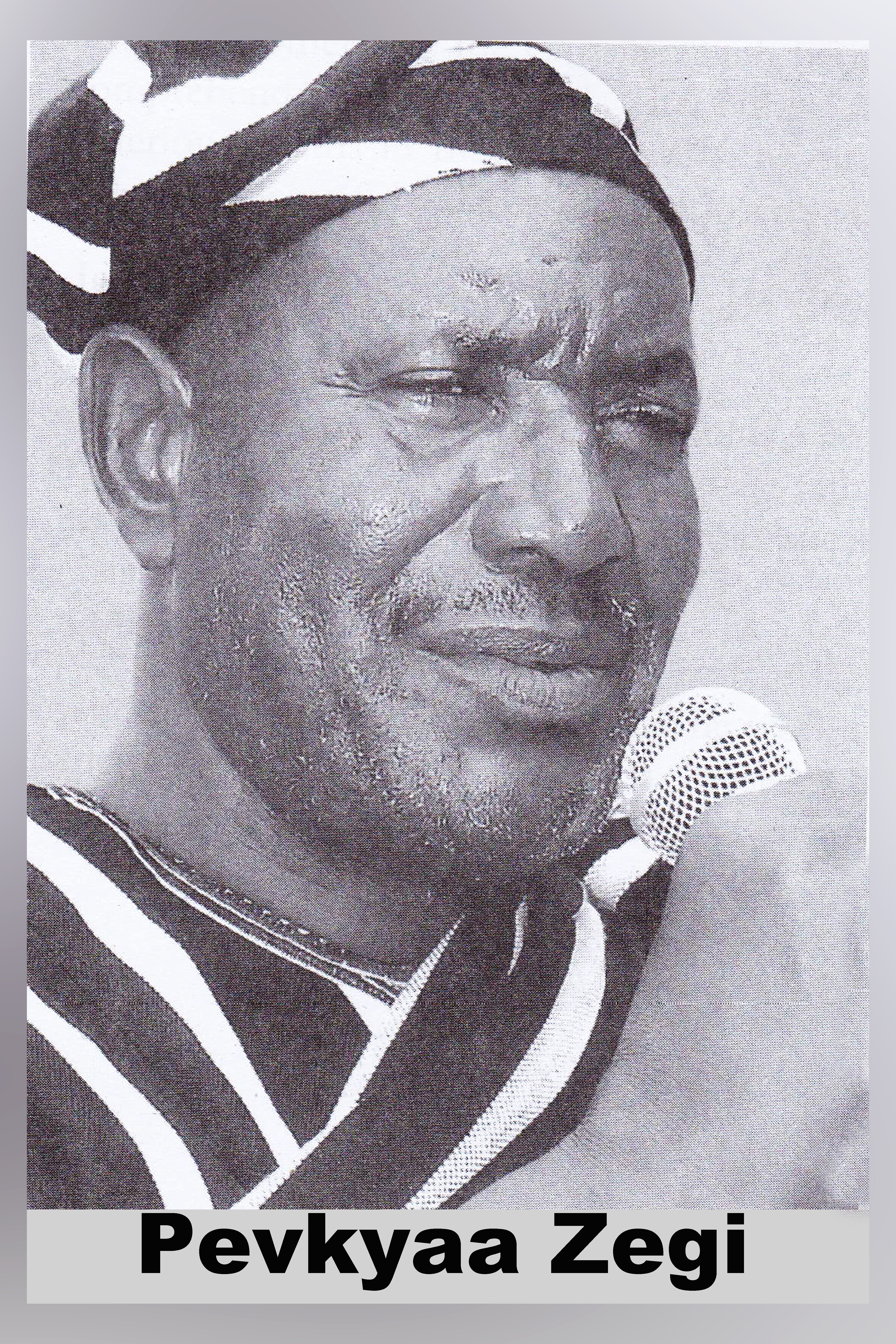
Pevkyaa Zegi (16 March 1944 – 2 November 2018) was a renowned Tiv folk singer, oral poet, and composer from Mbamena, Sherev (Ingyenev), Ukum in present-day Benue State, Nigeria. Widely associated with the Gbangi (Swange) musical tradition, he was celebrated for his gentle performance style, socially conscious compositions, and enduring influence on Tiv traditional music for over five decades. He is regarded as one of the most prominent and well-documented Tiv folk musicians of his generation.
Zegi was born in 1944 into the family of Iyangen (Yangen) Zegi in Mbamena. His birth date was recorded at the time by his maternal relative, Tule Tuse, an adult education teacher who documented it when he was born. Zegi later confirmed details of his birth through his brother, Dyur Atotse, during a visit to Kaduna.
He began his early education at Native Authority Primary School, Ngibo, in Katsina-Ala, and later attended Native Authority Primary School, Sankera between 1953 and 1959. He completed Primary Five but could not continue to Primary Six due to financial constraints, as free education ended at that level.
During his time at Ngibo, Zegi developed a deep interest in traditional music. Cultural performances regularly held at the compound of Tor Ngibo exposed him to oral poets and dancers, inspiring his eventual path as a performer.
Zegi came from a musical background. His biological father, Iyangen Zegi, was also a singer, although he later discontinued. Zegi maintained that success in music depended primarily on innate ability, noting that traditional enhancers such as Jiagba could only serve as a supplement, not a substitute for natural talent.
After leaving school, he refused to remain idle and began associating with established performers, particularly the Tiv oral poet Goddy Adigo and his associate, Ormbatsav Use. Although he was not formally an assistant, Zegi often accompanied them, and his voice blended so seamlessly with theirs that audiences sometimes mistook his contributions for a duet.
He began composing his own songs in 1964, and his musical direction became more defined following the eventual death of Adigo, which marked a turning point in his independent career.
Zegi’s music was rooted in the Gbangi genre, a traditional Tiv dance-music form originating from the Ihyarev area. The dance typically involved women carrying basins on their heads while performing, and the songs mirrored its rhythm and structure. At the time Zegi began his career, Gbangi was the dominant musical form and eventually supplanted earlier styles grouped under Aluabiam, which included songs such as Genyi u tôngon and Jiagwer.
He began composing actively in the mid-1960s and rose to prominence after the death of Goddy Adigo in 1969. Over time, he became one of the leading voices in Gbangi music, with his songs gaining widespread popularity, especially within Swange dance performances where they blended seamlessly.
A major turning point in his career came through the support of his patron, Justin Iche, who was based in Jos during the Benue-Plateau era. Impressed by Zegi’s music, Iche promoted him extensively, introducing him to broader audiences and helping establish his reputation across Tivland.
Zegi’s music was deeply rooted in social commentary and community advocacy. From the outset, he saw his singing as a service to his people rather than a means of personal enrichment. He deliberately avoided focusing on personal or material gain, choosing instead to address communal challenges such as poor road infrastructure, lack of electricity, agricultural concerns, and broader development issues.
His compositions spanned a wide range of themes, including:
He was also known for panegyric compositions that followed traditional praise-singing conventions, sometimes employing exaggeration in honoring patrons.
Zegi rejected the widespread belief that success in music required supernatural practices or human sacrifice, describing such assumptions as false. He maintained that his success was a product of natural talent, discipline, and the support of his community and patrons.
His performance style was widely described as gentle, clear, and captivating, characterized by simple language, memorable melodies, and non-ritualistic expression. His songs functioned not only as entertainment but also as tools for social mobilization and historical documentation.
Zegi was widely regarded as one of the foremost Tiv singers of his time. His status as “Number One” was solidified following the death of the prominent oral poet Tarker Golozo.
According to accounts, while Golozo was hospitalized in Mkar, he was asked by journalists who should succeed him. He reportedly named Pevkyaa Zegi as his choice. After Golozo’s death, Tiv traditional rulers summoned Zegi, stating that funeral arrangements would not proceed until he appeared.
Zegi attended the funeral and delivered an exceptional performance. Tiv elders subsequently affirmed that Golozo had effectively conferred the title upon him during his lifetime, leaving no contender. This recognition established Zegi as the leading figure in Tiv traditional music.
Zegi was his father’s only child. He often attributed his entry into music to economic necessity after leaving school due to financial hardship.
Over time, his success in music significantly transformed his personal life. Though he initially had no wife, his career enabled him to marry six wives and raise a large family. He had more than forty children, with forty-four identified as his biological children.
He also benefited from strong patronage networks and participated in traditional hosting events known as Imo mirin, where patrons organized elaborate gatherings featuring performances, feasting, and financial support in his honor.
Discover other Tiv artistes preserving our cultural heritage
Do you know a Tiv artiste who should be documented? Help us preserve our oral traditions and musical heritage for future generations.