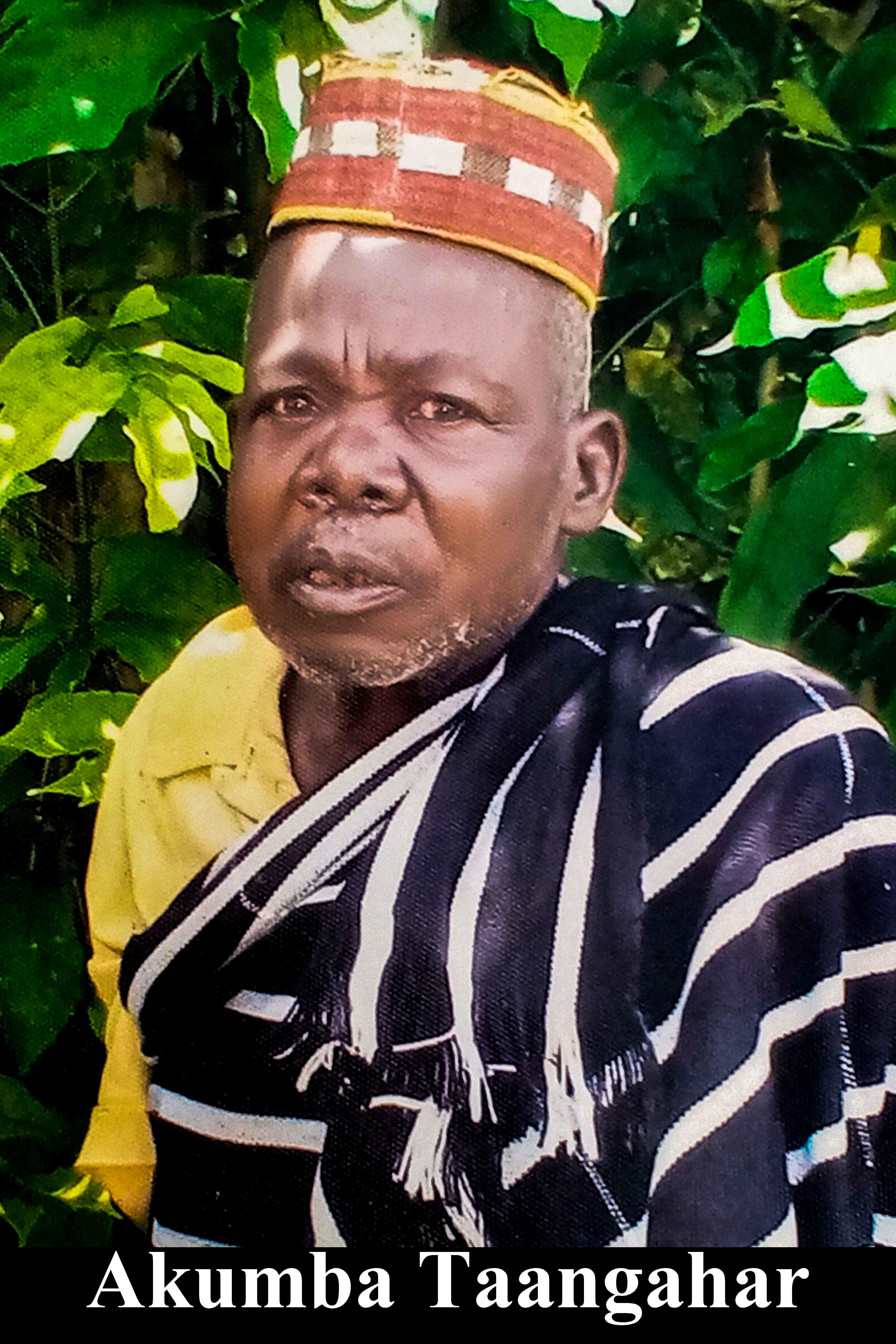
Akumba Taangahar was a Tiv composer, singer, and political prisoner best known for creating defiant prison songs during the political crises in Northern Nigeria in the late 1950s and mid-1960s. A native of Liev, Nyav, in Utange Council Ward of Ushongo, Benue State, Nigeria, he emerged as a powerful cultural voice whose music sustained imprisoned members and supporters of the United Middle Belt Congress (UMBC). Though little known publicly during his lifetime, his compositions became widely circulated across Tiv communities and remain significant in the region’s oral political history.
Taangahar participated in several popular Tiv dance traditions of his era, including Shen, Kwaza, Ikya, Ichegher, and Moba. He reportedly aspired to become a prominent Ichegher troupe leader but was unable to pursue this ambition fully due to family responsibilities, particularly the prolonged illness of his brother.
An early turning point in his artistic development occurred when colonial-era tax enforcement agents confiscated a prized family goat in lieu of unpaid tax. Although the animal was later redeemed, the incident provoked deep anger and grief, which Taangahar expressed through lamentations that evolved into song compositions.
During the political unrest involving the Tiv people and tensions between the Northern People's Congress (NPC) and the UMBC led by Joseph Sarwuan Tarka, Taangahar was arrested and imprisoned along with many activists. In detention, he composed songs that described the harsh conditions of prison life, ridiculed the authorities, and offered hope of eventual freedom.
His music gained extraordinary influence among inmates, becoming a source of emotional resilience and political solidarity. Prison officials reportedly attempted to ban his singing out of fear that it could incite unrest, but fellow prisoners resisted, leading to the restoration of his right to perform.
Taangahar’s songs predicted liberation and mocked oppression, themes that resonated strongly when General Yakubu Gowon granted amnesty to political prisoners following the 1966 military takeover. Former detainees carried these songs back to their communities, ensuring their widespread diffusion.
Despite the popularity of his compositions, Taangahar did not pursue music for material gain. According to oral accounts, a community elder later advised him to stop composing in order to preserve his life, believing the emotional intensity of his songs was spiritually dangerous. He complied, effectively ending his public musical career.
He lived quietly thereafter and remained largely unknown beyond those familiar with his work, even as his songs continued to circulate widely.
Taangahar died on 21 June 2012. Though often described as an “unsung hero,” he is regarded by scholars and political observers as a significant figure in Tiv cultural and political expression. His prison songs are remembered as powerful instruments of resistance, morale building, and social commentary during a turbulent period in Nigeria’s history.
Diplomat Chive Kaave and others have credited Taangahar’s compositions with inspiring later generations of political actors and preserving the memory of those who suffered imprisonment during the era. Today, his work survives primarily through oral transmission, symbolizing both the resilience of Tiv cultural traditions and the role of music in political struggle.
Discover other Tiv artistes preserving our cultural heritage
Do you know a Tiv artiste who should be documented? Help us preserve our oral traditions and musical heritage for future generations.